Getting started
Getting started · 6 min
How do you choose your size?
In a MarGueNée pattern, you do not choose a size from your ready-to-wear size, but from a measurement: the finished bust circumference of the garment. Your bust measurement and the ease of the design are all you need to find it.
Ease, seen from above
- Your bust circumference
- 95 cm
- Finished bust of the garment
- 110 cm
- Ease
- + 15 cm
A size number, a measurement
MarGueNée patterns come in up to sixteen sizes, numbered 1 to 16. This number is not a ready-to-wear size: it refers to the bust circumference of the finished garment, washed and blocked.
- Size 192 cm
- Size 296 cm
- Size 3100 cm
- Size 4104 cm
- Size 5108 cm
- Size 6114 cm
- Size 7120 cm
- Size 8126 cm
- Size 9132 cm
- Size 10138 cm
- Size 11144 cm
- Size 12150 cm
- Size 13156 cm
- Size 14162 cm
- Size 15168 cm
- Size 16176 cm
Example size chart: each number has its finished bust circumference.
Forget your usual size: only the measurement matters.
Measure your bust
Take the measurement around the fullest part of your bust, keeping the tape measure level and without pulling it tight.
Note it to the nearest centimetre: it is your starting point for every design.
Add the ease of the design
- Your bust circumference
- 95 cm
- Finished bust of the garment
- 110 cm
- Ease
- + 15 cm
Ease is the difference between the bust circumference of the garment and your own bust measurement. Each pattern gives its recommended positive ease: this is what gives the garment its intended drape. It changes from one design to the next: a few centimetres for a close-fitting garment, about twenty for a roomy sweater.
Where to find the recommended ease
- On the pattern page
- Sizes & ease
- In the pattern
- with the measurements
- In the web instructions
- at the measurements step
Each pattern page states the size and ease of the garment in the photos: a good guide to picture how it will look on you.
When a pattern gives no ease, for a children’s design for example, add the ease you would like.
Choose the closest finished bust
Add your bust measurement and the ease, then look in the pattern for the finished bust circumference closest to that number.
Bust measurementEaseFinished bust to look for
Example: 95 cm + 15 cm = 110 cm. In the pattern, look for the finished bust circumference closest to 110 cm.
Work it out for your pattern
Between two sizes
If the result falls between two sizes, compare the actual ease of each. In the example, 110 cm falls between 108 cm and 114 cm: for a 95 cm bust, size 5 gives 13 cm of ease and size 6 gives 19 cm. A little closer to the body, or a little roomier.
- Size 192 cm
- Size 296 cm
- Size 3100 cm
- Size 4104 cm
- Size 5108 cm
- Size 6114 cm
- Size 7120 cm
- Size 8126 cm
- Size 9132 cm
- Size 10138 cm
- Size 11144 cm
- Size 12150 cm
- Size 13156 cm
- Size 14162 cm
- Size 15168 cm
- Size 16176 cm
The web instructions do the maths for you: enter your bust measurement and they suggest the two closest sizes with their exact ease.
The gauge swatch keeps the promise
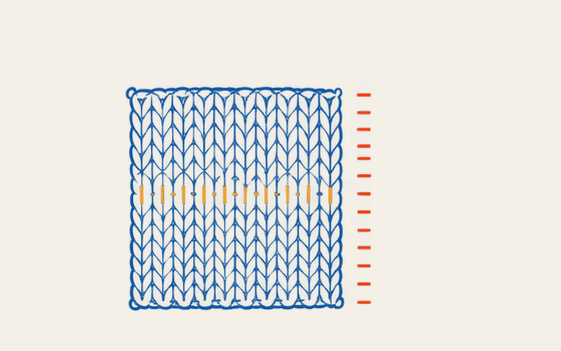
The measurements in the pattern are those of the finished garment, washed and blocked, knitted at the stated gauge. With a different gauge, the size you chose will not give the intended bust circumference.
Four things to look for
- 01
Measure your bust.
- 02
Add the ease recommended by the pattern.
- 03
Choose the closest finished bust circumference.
- 04
Check your gauge before casting on.
Next tutorial
How to knit an accurate gauge swatch