Sakae, finally a standalone pattern
First published in English in Making Stories Magazine in 2022, Sakae is back, entirely reworked: sixteen sizes, charts redrawn in colour, a French edition, and an illustration I made for page 1. It is finally available on Ravelry as a standalone pattern.
· 5 min read
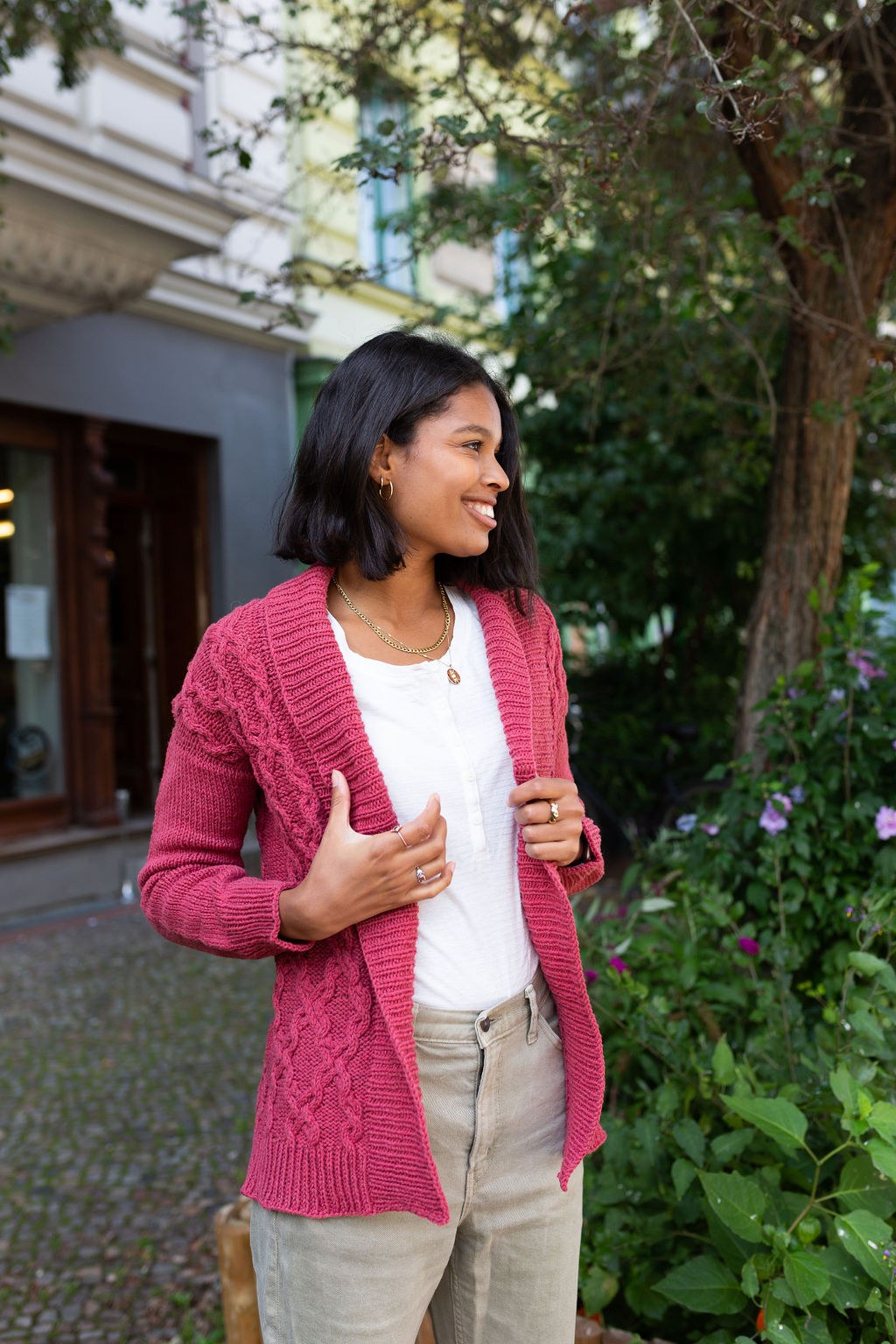
March 2022. Sakae is published for the first time, in English only, in Issue 7 of Making Stories Magazine. A big open cardigan covered in cables, which I had imagined during the pandemic.
More than four and a half years later, it is back. Entirely reworked, in sixteen sizes, in French for the first time… and finally on Ravelry as a standalone pattern.
A cardigan for my mum
Sakae was born from a very simple wish: to snuggle up in a big cosy cardigan, with pleasure and serenity, surrounded by my family. When the pandemic swept away the way we related to others, it became essential to refocus on ourselves in order to take care of those we love.
And I designed it thinking of my mum. It was very hard for her to know we were far away, without being able to see us. This cardigan, I would knit it for her.
What better way to take care of our loved ones than to wrap them in the love we put into our knits?
A first life in a magazine
Sakae first lived in the pages of Issue 7 of Making Stories Magazine. Until now, it only existed in English, and it did not have its own page on Ravelry, like my other patterns.
While reworking it, I realised that the 2022 text described a sweater rather than the cardigan in the photos in places, and that its charts did not quite match the knitted pattern. It also came in only ten sizes.
Reworking everything
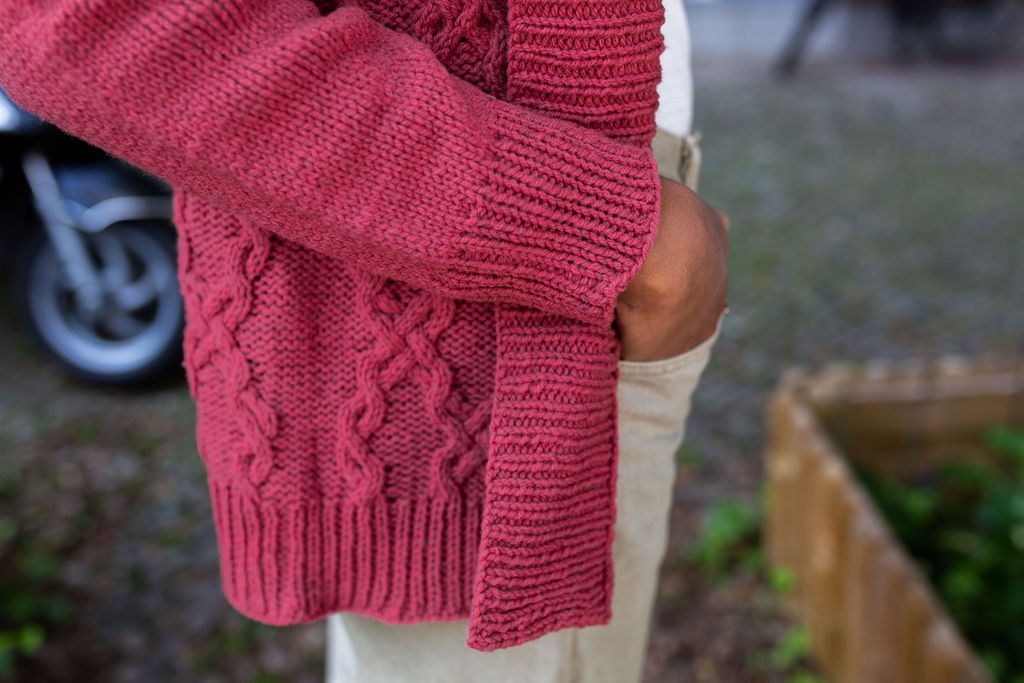
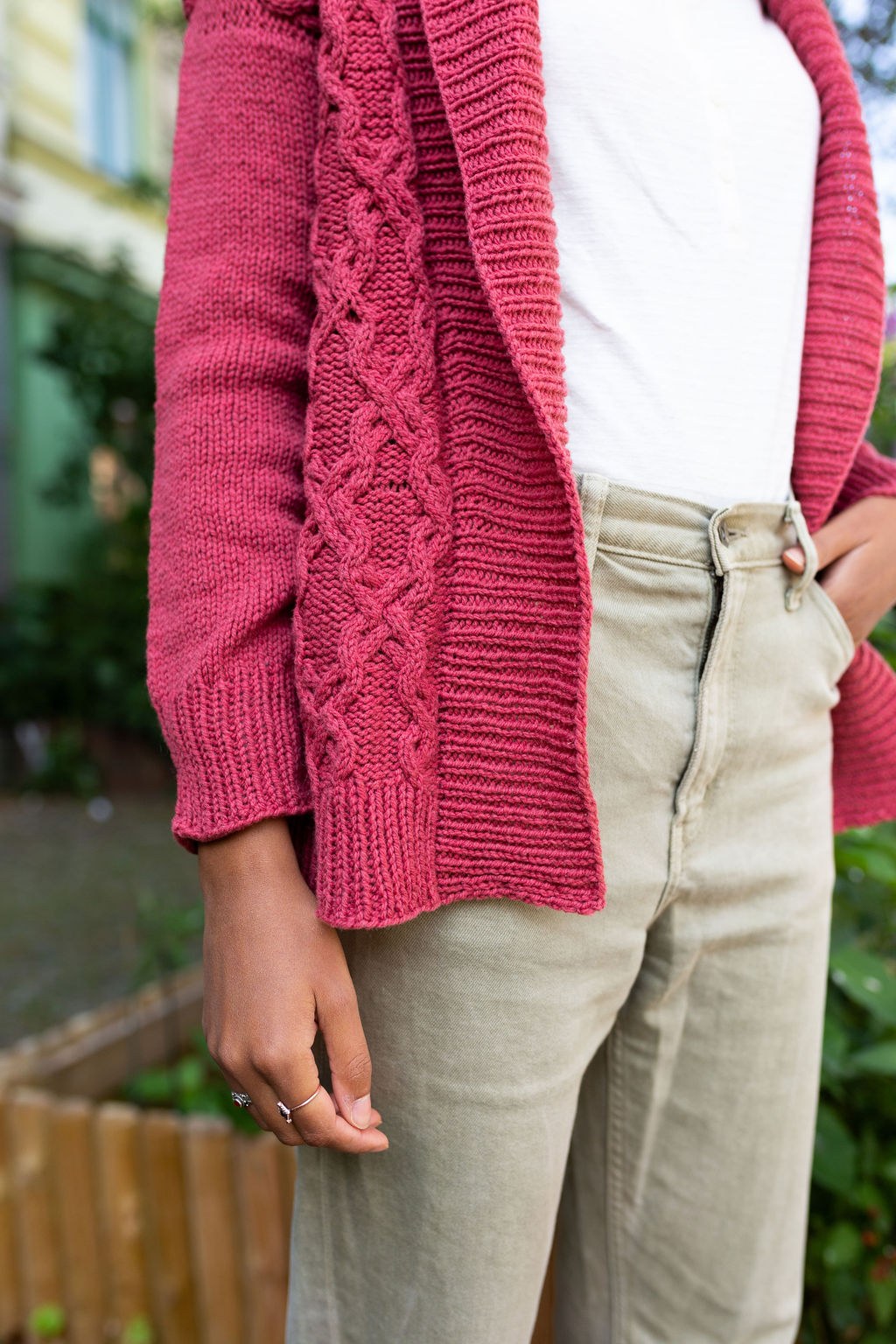
So I reworked everything, starting from the photos and my files from the time. Sakae is an open cardigan, worked from the top down. The back and front shoulders are shaped with short rows, each on its own chart, and the pattern runs right up to the neckline edge.
The front neckline then widens gently, with one increase every 4 rows. The back and the two fronts are joined at the underarm, and the body continues down to the bottom ribbing, with its cables.
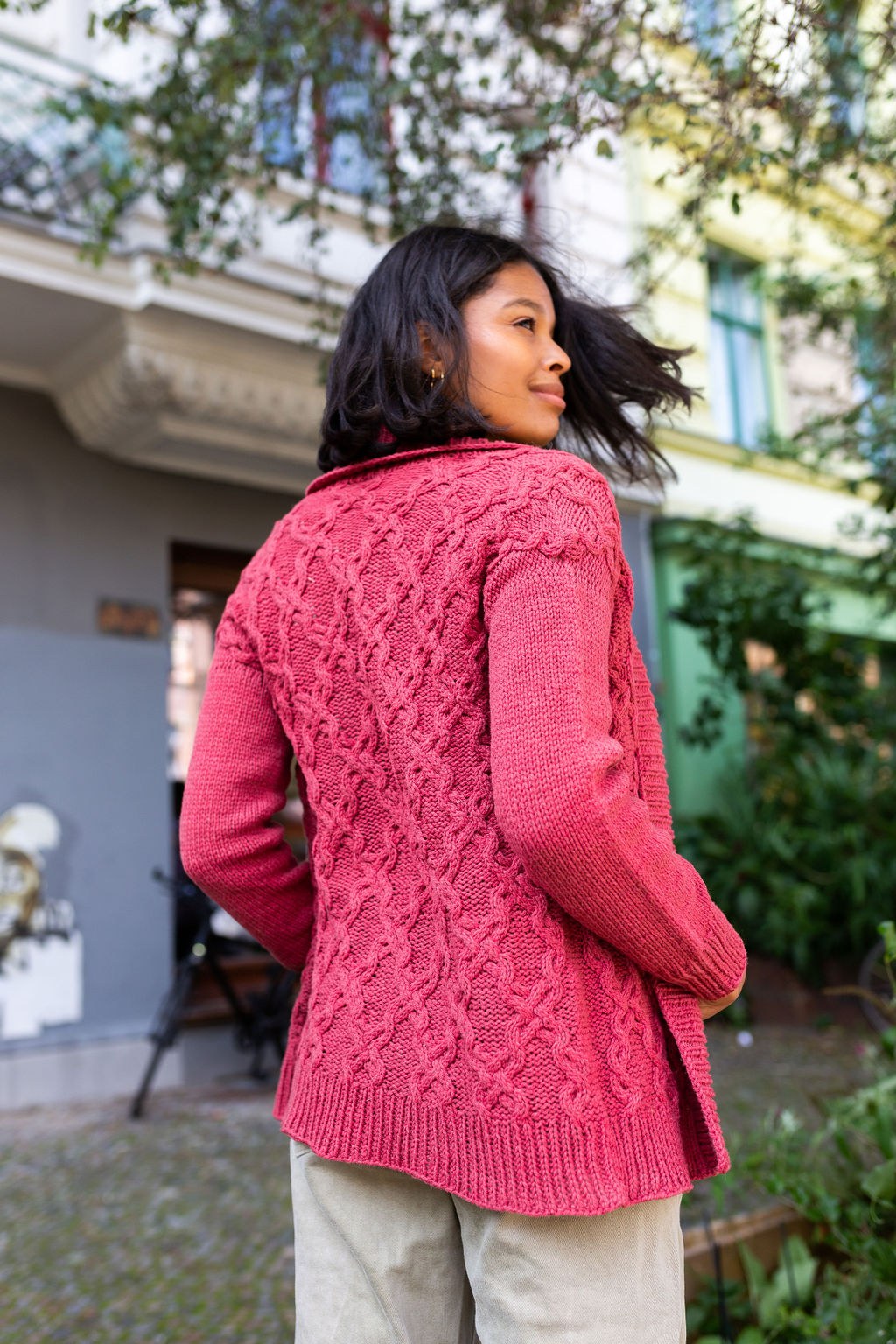
The 2/2 rib band is picked up at the end, all around the fronts and the back neck. It deepens at the neck into a true shawl collar: 6 in / 15 cm at the back neck, 2¾ in / 7 cm at the bottom of the fronts. The sleeves are picked up around the armhole and decreased evenly down to the ribbed cuff.
The pattern goes from ten to sixteen sizes, numbered 1 to 16, for a finished bust of 37¾ to 70¾ in / 96 to 180 cm. The charts are redrawn in colour, size by size, each with its key, and the appendix index gives the pages of your size, so you only print those.
An illustration on page 1
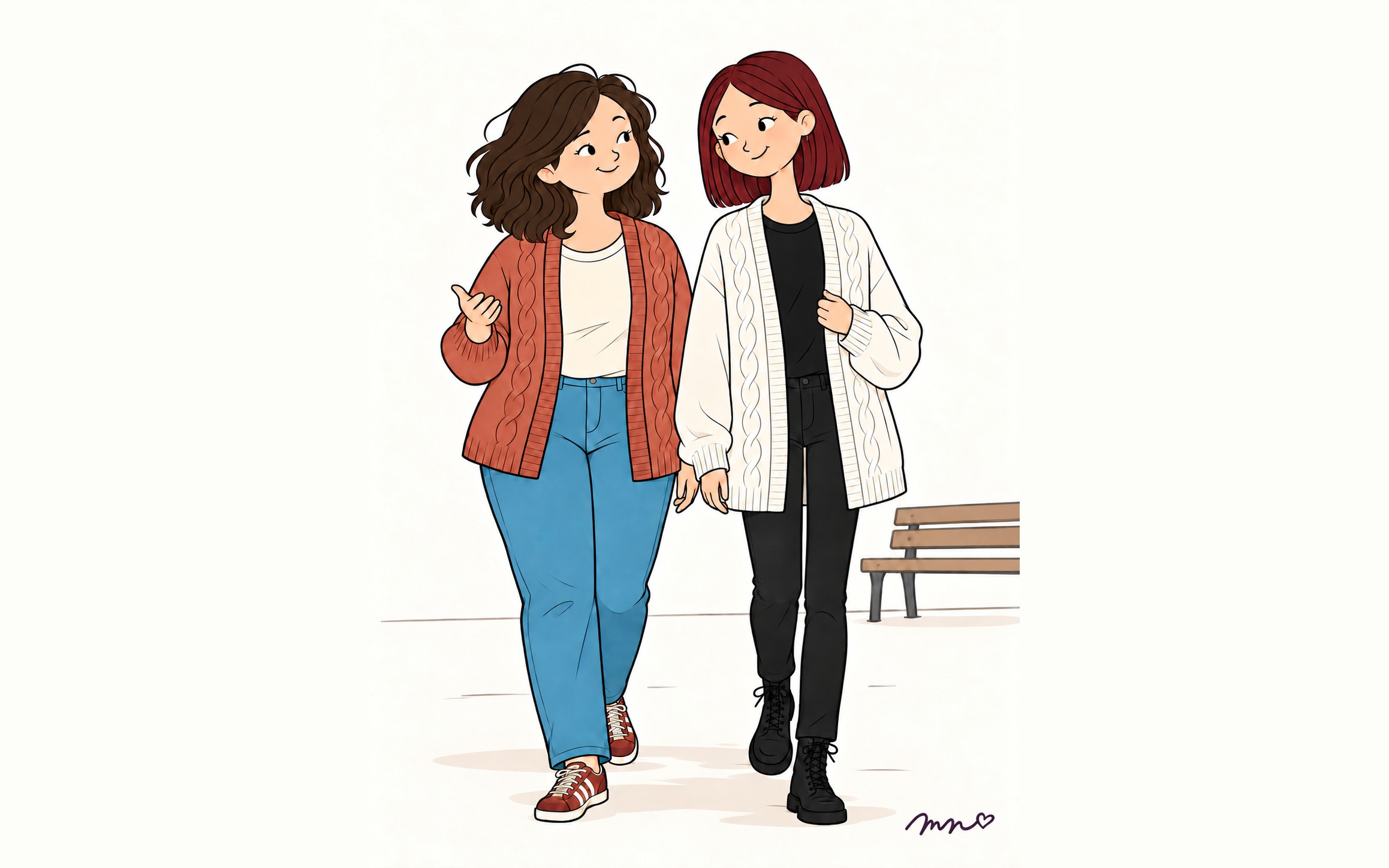
For this new version, I wanted a page 1 that looks like me. So I made an illustration myself: my daughter Charlotte and me, out for a stroll, each in our own Sakae.
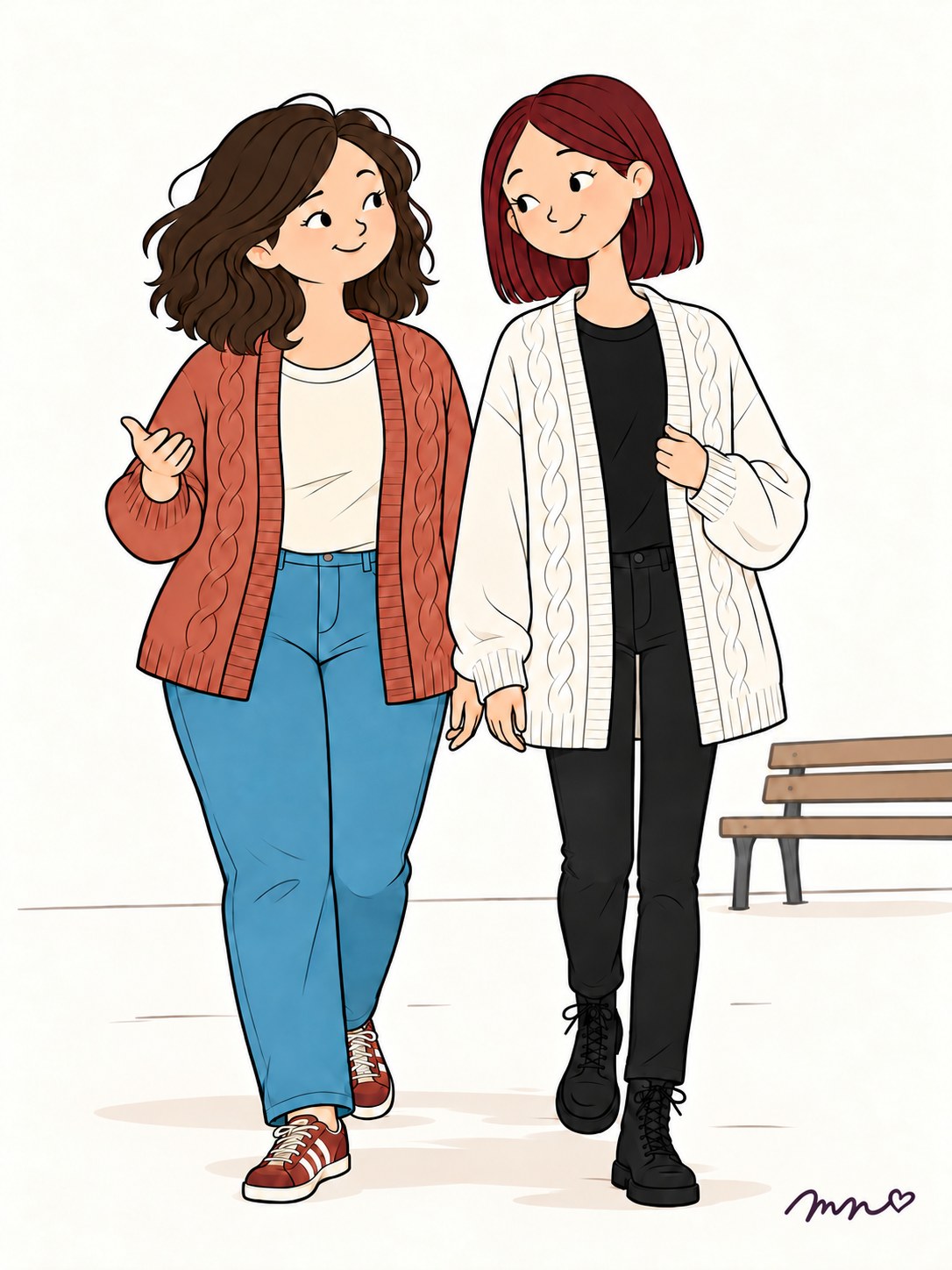
Mine is rosewood, over a cream top and blue jeans, with matching sneakers, as always. Charlotte’s is white, over a black T-shirt, and she wears it with much more ease than I do: a real cocoon that wraps her up entirely.
That is exactly what I love about this cardigan. The same pattern, the same construction, the same cables… and two ways of wearing it, depending on the person and on the ease you choose.
And at the bottom right, you will find my signature: two linked m’s, whose last stroke flows into a little heart. It is the signature I used to draw when I was a child.
There is a sweet nod in this picture too. Sakae was born thinking of my mum; here it is, drawn on me and on my daughter.
Gilliatt, and lots of softness
Sakae is knitted in De Rerum Natura Gilliatt, a 100% merino with 273 yd / 250 m per 100 g, on US 8 / 5 mm needles, and US 7 / 4.5 mm for the ribbing and the band. You will need 4 to 9 skeins depending on the size.
The gauge is 18 stitches and 24 rows to 4 in / 10 cm in stockinette, and 20 stitches and 22 rows to 4 in / 10 cm in pattern. I recommend 6¾ in / 17 cm of positive ease: Sakae is meant to be worn roomy, like a hug. And like Charlotte, nothing stops you from adding even more.
Finding Sakae
Sakae is available on Ravelry as a standalone pattern, in English and French. If it was already in your Ravelry library, the new version is waiting for you there: remember to download it.
To celebrate its return, enjoy 15% off with the code SAKAE, to enter at checkout, until 1 November at midnight (Paris time).
- Sakae on Ravelry: https://www.ravelry.com/patterns/library/sakae
And you, who would you knit your Sakae for? Tell me in the comments!